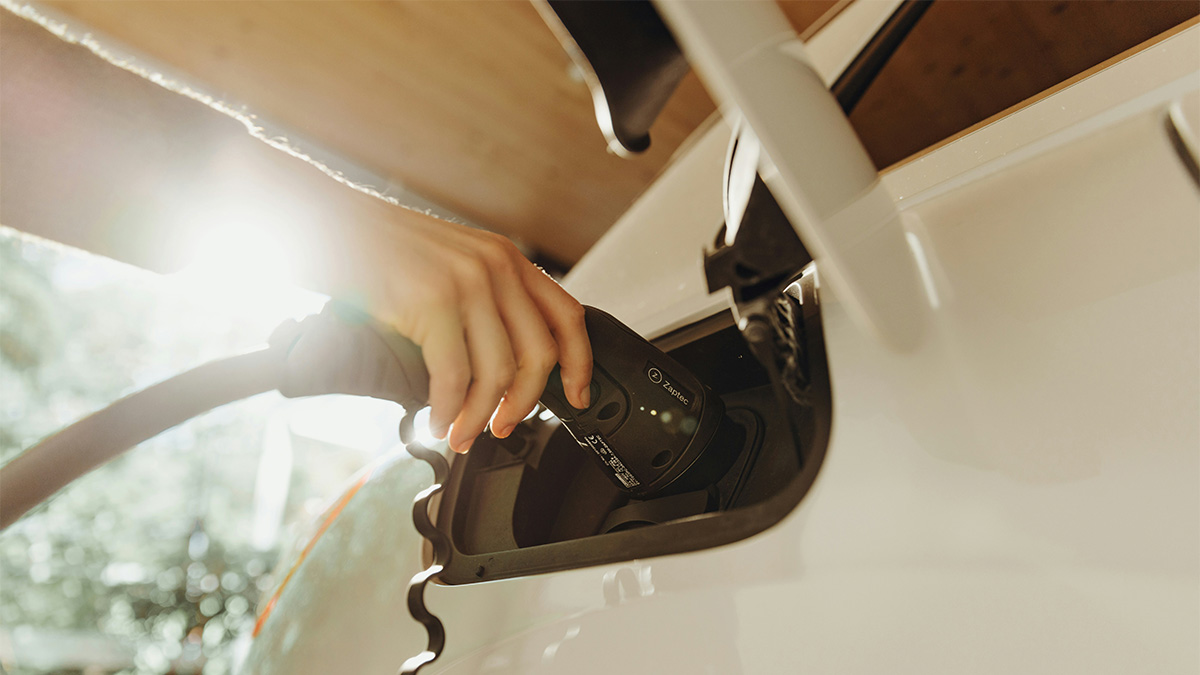
Charging at Home – Company Cars
You can claim the cost of electricity used to charge your electric company car at home without triggering a Benefit in Kind (BIK).
This is great for both employers and employees, as it makes reimbursing home charging costs simpler and more tax-efficient, while also supporting the shift toward electric vehicles.
To qualify for this exemption, you must be able to demonstrate:
- The electricity being reimbursed was used specifically to charge a company car or van.
- The reimbursement relates only to the car or van, not to general household electricity use.
Whether the car is then used for business or private purposes, the whole amount can be claimed from the company as an exempt benefit.
Tracking Electricity Usage
A key practical challenge is proving how much electricity is used solely for vehicle charging. Fortunately, there are now various apps and smart charging devices available that can accurately track energy consumption.
As long as you have reliable evidence showing the electricity relates only to the company vehicle, this should be sufficient to support an expense claim.
If the employer pays to install a charger at the employee’s home, this is also an exempt BIK.
Other company car expenses, such as insurance, repairs, and road tax are also exempt from BIK.
Charging at Home – Employee-Owned Car
If the electric vehicle is owned by the employee and they use the vehicle for business mileage, they would claim back mileage from the employer at the normal rate of 45p for the first 10,000 miles in a tax year and 25p thereafter.
Charging at Work
If an employee charges their electric vehicle at work, there is no BIK, even if the vehicle belongs to the employee rather than the company.
Advisory Electric Rates – Company Cars
If you would prefer to track mileage rather than electric used at home to charge the vehicle, or if your home charger cannot give you the data to prove how much has been used on the vehicle, you can claim mileage instead.
HMRC’s Advisory Fuel Rates change every quarter based on fuel prices but the advisory electric rate is currently 7p per mile for home charging and 15p per mile for public charging.
For journeys where a company car is charged at both public and residential locations, you can apportion the mileage based on how much charging happens at each place. The apportionment calculation should be fair and reasonable.
You might be thinking that it’s unusual to find a public charger for 15p per mile, especially at the motorway services. A higher amount than the advisory rates can be used as long as you can show that the fuel cost per mile is higher. Therefore, if the public charger used is higher in cost per mile than the new advisory rate introduced for public charging, a higher rate can be used as long as you can show the cost per mile is higher.
Hybrid cars are treated as either petrol or diesel cars for advisory fuel rates.
The advisory fuel rates are published here – https://www.gov.uk/guidance/advisory-fuel-rates
Need More Guidance?
HMRC has published helpful flowcharts to clarify the tax treatment of EV charging in different scenarios. These can be accessed via their Employment Income Manual here – https://www.gov.uk/hmrc-internal-manuals/employment-income-manual/eim23900
If your business operates company electric vehicles, it’s worth reviewing your reimbursement policies to ensure you’re making the most of these changes.

Speak to an accountant
Book a meeting at a time that suites you and we can give you a no obligation quote.